Innovation is the key to success in the dynamic world of tech startups. It’s the driving force that propels businesses forward. But how can startups ensure their innovative ideas are feasible and viable? This is where POC development services come in—helping validate concepts before investing in full-scale development.
Enter POC development services.

POC, or Proof of Concept, is a critical step in the software development process. It’s a method used to verify if a concept or idea can be turned into a reality. It’s about testing the waters before diving in. POC development services are not just about technical validation. It’s also about business validation. It helps startups understand if their idea can solve a real-world problem and if there’s a market for their solution.
Developing a POC can save startups from costly mistakes. It allows them to identify potential issues early on, reducing risks and saving resources. It’s about being smart with your investments. But POC development services is not a one-size-fits-all process. It requires careful planning and execution. It’s about setting clear objectives, building a prototype, and gathering valuable feedback.
POC development also plays a crucial role in decision-making. It helps startups decide whether to proceed with full-scale development or pivot to a different idea. It’s about making informed decisions. Moreover, POC development can be a powerful tool for attracting investors. A successful POC can demonstrate a startup’s potential, making it more attractive to funding. It’s about proving your worth.
But how does POC development services differ from MVP or Minimum Viable Product? While both are important, they serve different purposes and are used at different stages of the development process. Understanding the difference is key.
In this article, we’ll delve deeper into the world of POC development. We’ll explore its role in accelerating innovation in tech startups, how to effectively develop a POC, and how it compares to an MVP. We’ll also look at successful POC implementations and the lessons we can learn from them. So, whether you’re a tech startup founder, a product manager, a software developer, or simply someone interested in the software development process, this article is for you. Let’s embark on this journey of discovery together.
Introduction to POC Development Services
Proof of Concept (POC) development is a cornerstone in the tech world, especially for startups. It’s a strategy that provides validation before significant resources are invested. At its core, POC is about demonstrating that an idea is feasible. Tech startups are inherently risky ventures. They often deal with innovative but untested ideas. POC development services as a safety net in this scenario. It allows startups to test their ideas in a controlled manner.
By identifying potential problems early, POC reduces risks significantly. This early-stage testing helps avoid costly errors later. Consequently, startups can save time and resources. Also, POC development is an iterative process. It involves continuous feedback and refinement. This approach ensures that the final product is well-aligned with market needs.
It’s crucial for startups to stay ahead of the competition. Quick adaptation to market demands is essential. POC development services offers an accelerated path to market readiness. It helps startups iterate rapidly on their concepts. In summary, POC development is not just about technology. Understanding whether there’s a market need is the first step. Equally important is ensuring that a startup’s idea is both feasible and valuable. This critical process combines innovation with pragmatism.
Definition of POC in Software Development
A POC in software development is a small exercise to test a specific concept. The goal is to determine if an idea is practical. It verifies whether an idea can be developed into a feasible solution.z
Unlike a prototype, a POC is not a working model. It lacks detailed functionalities or comprehensive features. Instead, it focuses on proving the core idea or technology. The POC acts as a research tool, providing essential insights. It answers critical questions regarding technical feasibility. It explores the potential for real-world applications.
In software, technical feasibility is paramount. A POC explores whether the concept can be built technically. It identifies technical constraints that may impede development. Moreover, POC helps refine ideas. It offers clarity on which aspects need development. This ensures that resources are allocated effectively during full-scale development.
For startups, this initial validation is invaluable. It builds confidence among stakeholders and potential investors. They can see tangible evidence of the idea’s potential. Therefore, a POC is a strategic asset.
Importance of POC in the Startup Environment

In the fast-paced startup ecosystem, uncertainties abound. POC development services offer a method to navigate these uncertainties. It provides a structured approach to test novel concepts. For startups, speed is often crucial. The quicker a product can reach the market, the better. POC development services facilitates this by accelerating decision-making processes. It shortens the gap between idea and execution.
Additionally, in startups, resources are often limited. Wasting them is not an option. POCs enable startups to focus on viable paths. They act as a filter to identify promising ideas before deep investment.
A POC also informs business decisions. It helps validate market assumptions. Understanding if a target market exists for a concept is vital for a startup’s success. The startup environment is competitive. A well-executed POC provides a leg up. It demonstrates innovation and feasibility. Startups with a strong POC can attract early adopters.
In conclusion, a POC is an important tool for startups. It helps manage risk, save resources, and speed up the time-to-market. By doing so, it lays a strong foundation for future success.
Role of POC in Software Development
POC in Software Development plays a pivotal role in software innovation. It bridges the gap between conceptualization and implementation. It acts as a litmus test for new ideas, revealing what works and what does not. One crucial function of POC in software is to demonstrate technical feasibility. It provides initial proof that a product or concept can be developed using existing technology. This is vital before committing to full-scale development.
POC also helps to identify potential risks early in the development process. By exposing flaws and limitations, it allows developers to address issues proactively. This prevents costly mistakes down the road.
Moreover, POC facilitates stakeholder engagement. A tangible demonstration of a concept increases stakeholder confidence. It provides something concrete to discuss and refine, aiding in making informed decisions. The iterative nature of POC in Software Development supports the Agile methodology. It embodies the fail-fast philosophy, encouraging rapid iterations. This fosters innovation by allowing more room for experimentation and creativity.
Finally, POC is not solely about technology. It’s about understanding user needs and expectations. It aligns the development process with market realities, ensuring that the final product is relevant and valuable.
Addressing Market Needs with POC
Understanding and addressing market needs is paramount for any tech startup. A well-executed POC provides valuable insights into these needs. It offers a glimpse into market expectations and user behaviors. POC development lets startups test different hypotheses about market requirements. By doing so, they can determine which features users most desire. This knowledge is instrumental in product prioritization.
By focusing on core functionalities, a POC identifies what users value most. This helps in aligning the product with actual market demands. It ensures that the product delivers real solutions to real problems. The feedback loop during POC development is vital. It presents an opportunity to engage with early adopters. This feedback offers immediate insights into user experiences and unmet needs.
Additionally, POCs help gauge market readiness for a new concept. Is the market prepared for innovation, or does it need more education? Understanding this context ensures a more strategic launch strategy. In essence, POC acts as a bridge between technology and users. It helps startups refine their understanding of the market, ensuring their solutions are on point. By addressing market needs effectively, startups can carve their niche in competitive landscapes.
Validating Ideas through POC Development
Ideas form the backbone of startups, but validation is key. POC development is a powerful tool for this purpose, enabling startups to test the viability of their concepts early on. POCs offer an organized structure for validating assumptions about a product. They explore whether an idea can practically translate into a functioning solution. This is fundamental before investing heavily in development.
By identifying technical and non-technical challenges, POCs provide clarity. They uncover whether the proposed solution is sustainable and practical. Addressing these issues early fosters stronger, more viable products. Engaging stakeholders early is beneficial during validation. A compelling POC can secure support from investors and partners. It serves as a concise demonstration that an idea is both innovative and feasible.
The insights gained from a POC guide strategic decisions. Startups can evaluate if it’s worth proceeding with an idea based on POC feedback. They either refine their approach or pivot based on these learnings.
Ultimately, POC validation ensures that startups pursue the right ideas. It minimizes risk by confirming assumptions and aligning with market opportunities. In validating concepts, POCs lay the groundwork for successful development and innovation.
POC vs MVP: A Comparative Look
In the tech world, POC and MVP play vital roles. Each serves different purposes in the product development lifecycle. Understanding their differences helps startups deploy resources wisely.
Key Differences Between POC and MVP
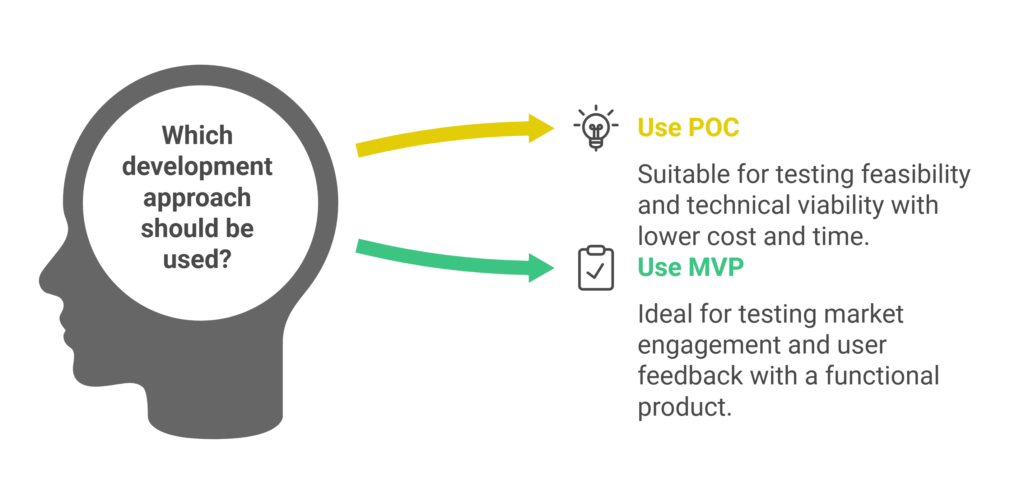
A Proof of Concept (POC) primarily aims to test an idea’s feasibility. It answers the question: Can this idea be built? POCs focus on proving technical viability without full product functionality.
On the contrary, a Minimum Viable Product (MVP) is a functional version of a product. It includes core features to satisfy early adopters. MVPs are built to test real user interactions and gather feedback. While POCs are often used to validate a single hypothesis or component, MVPs test the market. MVPs help startups understand if users will engage and find value in their products.
The development time for a POC is generally shorter. It involves less comprehensive testing than an MVP, which requires a complete iteration cycle. MVPs demand more refinement and usability, as they’re intended for real-world use. POC development involves lower budgets compared to MVPs. This is due to their limited scope. However, MVPs may require more investment because they need market-ready experience.
Startups use POCs to substantiate an idea before moving to full development. Conversely, MVPs serve as a stepping stone toward full-scale production, allowing startups to iterate based on user input and market dynamics.
Situational Use: When to Choose POC Over MVP
Choosing between a POC and an MVP depends on specific objectives. A POC is ideal when the main goal is to validate technology feasibility. It is suitable when the concept involves innovative technology or untested approaches.
In scenarios where the technical aspect is uncertain, a POC is preferred. It provides initial clarity on whether an idea can work without committing to full functionality. POCs are also valuable when pitching to investors. They offer a quick demonstration of potential, focusing on technical possibilities. This way, they help secure funding based on innovative merit.
Conversely, an MVP is more appropriate when testing market interest. If the feasibility is already proven, an MVP lets startups understand user engagement and refine based on real-world use. Choosing a POC helps reduce risk when unknowns are primarily technical. It prevents unnecessary expenditure on ideas that aren’t technically viable. Meanwhile, opting for an MVP when market conditions are the focus minimizes effort on development features not valued by users.
POCs or MVPs both serve unique functions. The choice between them should align with strategic goals and the current stage of product development. Understanding their roles ensures startups maximize their resources while fostering innovation.
Steps to Develop POC Effectively
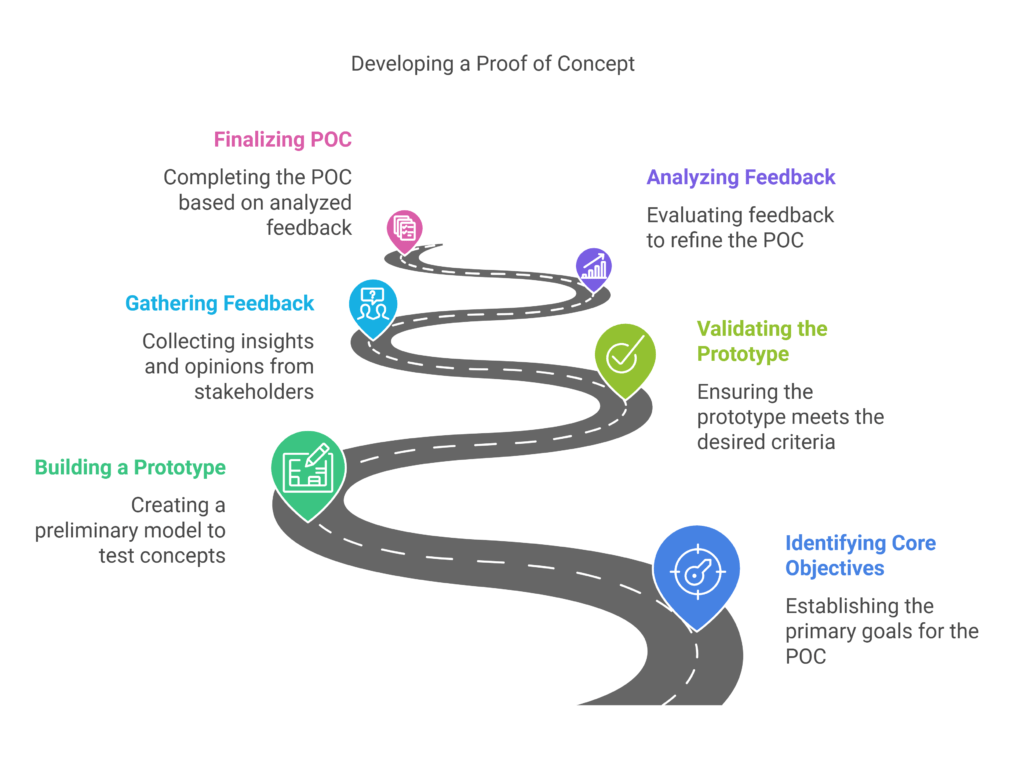
Developing a Proof of Concept (POC) is pivotal for innovative tech ventures. Each step in the process brings you closer to transforming ideas into realities. This section guides you through a streamlined approach to crafting an effective POC.
Identifying Core Objectives
Every successful POC starts with clear objectives. Defining what you aim to prove sets the foundation. It aligns your team’s efforts and keeps the focus sharply directed. Begin by pinpointing the key question your POC needs to answer. Is it assessing technical feasibility, exploring a new technology, or proving a business concept? Establishing these goals helps tailor the approach and scope.
Engage stakeholders early in this stage. Collaborating with them ensures that the objectives resonate with broader business needs. This participatory approach also heightens commitment to the project’s success. Once objectives are set, break them into manageable components. Define the metrics for success. Knowing how you’ll measure achievements helps keep the process transparent. It allows for adjusting strategies, keeping the POC both relevant and efficient.
Building a Prototype for Validation
With your objectives in place, the next step is constructing a functional prototype. This prototype serves as a tangible representation of your idea. It’s the physical manifestation of conceptual theories. Start simple. Focus only on the core features necessary to test your initial hypotheses. This method prevents over-complication, keeping the development process agile and swift.
Use iterative development techniques. Each iteration brings improvements based on testing and feedback. These cycles not only sharpen the functionality but also allow for quick pivots, enhancing adaptability. Choose the right tools and technologies for building your prototype. Lean towards those that offer flexibility and scale. Tools should support rapid prototyping and easy modifications, which are essential traits for any successful POC.
Gathering and Analyzing Feedback
After crafting your prototype, it’s time to gather feedback. Insights from user interactions are invaluable. They often reveal unforeseen challenges and unexpected opportunities. Engage a diverse group of testers. Diversity in feedback brings a wider range of perspectives, crucial for robust product development. Include potential users, stakeholders, and experts who can provide constructive criticism.
Collecting feedback should be structured yet flexible. Surveys, interviews, and direct testing sessions are useful. They yield qualitative and quantitative data to guide further refinements. Analyze the feedback meticulously. Look for patterns in user interactions that indicate how well the POC meets its objectives. Identify both strengths and weaknesses and consider suggestions for enhancement.
Lastly, translate insights into actionable plans. Implement changes in a way that aligns with the initial goals and improves the user experience. Continuous iteration based on feedback ensures the POC evolves, maintaining its relevance and effectiveness.
Case Studies of Successful POC Implementations
Successful POC implementations offer valuable insights for aspiring tech startups. By examining real-world examples, we can learn practical lessons about execution and outcomes.
Notable Examples in Tech Startups
One compelling example is Dropbox. Before becoming a household name, Dropbox was a simple POC video showing how users could easily sync files across devices. This straightforward demonstration effectively conveyed the value proposition to potential investors and early adopters, highlighting the core functionality without needing a full-fledged product.
Airbnb’s early days also revolved around a POC approach. The founders initially rented out air mattresses in their apartment, capturing the experience and showcasing it to test the concept. This grassroots method of proving market interest laid the groundwork for a platform that would redefine the hospitality industry.
Another noteworthy case is Slack. Initially developed as an internal communication tool for a gaming company, Slack emerged from a POC that addressed specific team collaboration needs. By focusing on user experience and iterating based on feedback, it quickly evolved into an indispensable product for businesses worldwide.
These startups illustrate the power of POC in validating innovative ideas. They strategically used POCs to test assumptions, demonstrate value, and secure essential support from stakeholders. This approach not only facilitated product development but also accelerated their journeys from startup to market leader status.
Lessons Learned from Real-world POCs
Real-world POCs teach us the importance of simplicity in execution. Dropbox’s video, for instance, showed that an effective POC need not be complex or resource-intensive; it just needs to address the core user need clearly. The adaptability seen in Airbnb’s story highlights the value of real-world testing environments. Their approach underscored the benefit of direct engagement with potential users to refine the concept based on authentic experiences and reactions.
Slack’s evolution underscores the critical role of iteration. Frequent iterations allowed the startup to promptly incorporate user feedback, refining the product to better suit market needs. This iterative process ensured that the final offering was well-aligned with user expectations and pain points. From these examples, it’s clear that a focus on user-centric design is crucial. Empathy toward users’ needs and behaviors, coupled with regular feedback loops, can significantly impact the success of a POC. Furthermore, leveraging POCs to explore potential scalability and broader market applications can set a strong foundation for growth.
All these learnings emphasize that the true value of a POC lies not only in proving a concept but also in using the journey to gather insights that inform strategic decisions, product development, and market entry strategies.
Conclusion: POC as a Catalyst for Innovation
POC development plays an indispensable role in driving innovation within tech startups. It allows startups to explore new ideas without committing extensive resources upfront. By focusing on critical features, POCs help teams concentrate on validating the concept’s feasibility and potential. This approach reduces risk and accelerates learning cycles. As startups experiment with various solutions, POCs become a vital step in refining and focusing ideas that align with market demands.
Furthermore, POC development fosters a culture of creativity and experimentation. It encourages teams to think critically about the problems they aim to solve and explore various pathways. This creative freedom can lead to groundbreaking innovations and strategic insights. Ultimately, by serving as an effective tool for validation, POCs give startups a competitive edge. They enable swift adaptation, continuous iteration, and improved decision-making. As a result, POCs not only catalyze product development but also enhance startup survival and success in dynamic markets.
Summary of POC Benefits for Startups
POCs offer a practical path for startups to validate ideas and gain insights with minimal investment. They provide concrete evidence of technical feasibility and market viability. By focusing on core functionalities, startups can test the waters and gather feedback without building a complete solution. This approach not only saves time but also minimizes financial risk.
Additionally, POCs facilitate stakeholder communication by offering tangible demonstrations of progress and potential. They can help startups secure funding, attract early adopters, and align team efforts around validated concepts. The iterative nature of POCs ensures continuous learning and product refinement, ultimately boosting innovation and competitive positioning. In essence, POCs empower startups to strategically navigate uncertainty and develop robust offerings that resonate with their target market.
Future Trends in POC Development
The future of POC development is set to be shaped by advancing technologies and changing market expectations. As industries embrace digital transformation, startups will increasingly utilize POCs to test cutting-edge technologies like AI, blockchain, and IoT. The use of low-code and no-code platforms is expected to rise, enabling faster and more cost-effective POC development.
Furthermore, POCs will likely play a crucial role in sustainability efforts. Startups could leverage POCs to explore eco-friendly solutions and measure their impact on the environment. The trend towards remote work and distributed teams will also influence POC processes, fostering collaborative tools and virtual environments. This evolving landscape will keep POC development at the forefront of innovation, driving new capabilities and opportunities for startups worldwide. In this context, startups will continue to rely on POCs as a strategic tool to refine their approaches, adapt to market shifts, and push the boundaries of what’s possible.

 By
By
 By
By