
In the world of SaaS product engineering, delivering fast, scaling seamlessly, and iterating confidently are non-negotiables. Whether you’re building a fintech MVP, a healthcare SaaS platform, or an internal enterprise tool, your app’s architecture directly influences time-to-market, scalability, and reliability.
That’s where the 12-Factor App methodology comes in—a proven set of engineering principles created by Heroku, specifically designed to help SaaS teams build modern, cloud-native applications that scale across environments and user bases.
Why 12-Factor Matters for Product Engineering in SaaS
Building a SaaS product is not just about writing code—it’s about creating a platform that can:
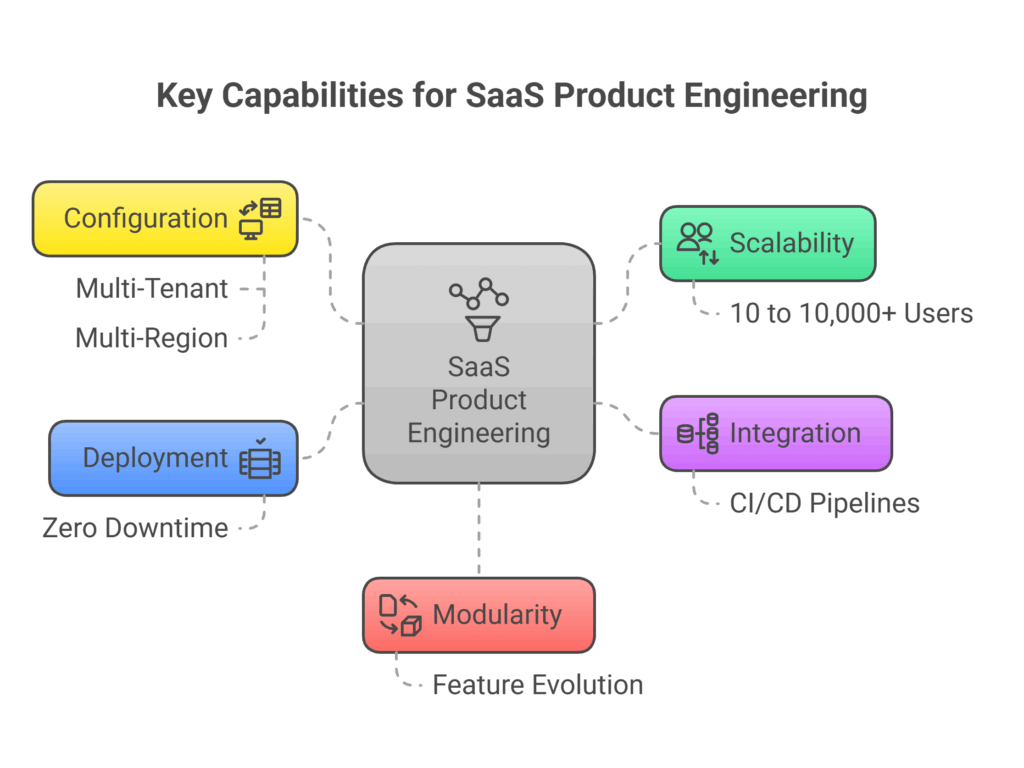
- Scale from 10 to 10,000+ users
- Integrate seamlessly with CI/CD pipelines
- Handle configuration for multiple tenants or regions
- Enable frequent releases without downtime
- Support modularity for evolving features
The 12-Factor App provides a practical and philosophical foundation for this kind of engineering rigor. Let’s explore how each factor connects directly with SaaS product development.
The 12 Factors for SaaS Product Engineering
1. Codebase — One codebase tracked in version control, many deploys
Your SaaS product should have a single source of truth—a version-controlled codebase (e.g., Git). Even if you have multiple environments (development, staging, production), they should all be based on the same codebase with environment-specific configurations handled separately.
Why it matters in SaaS:
- Prevents code drift across environments
- Enables consistent deployments
- Simplifies bug tracking and feature development
2. Dependencies — Explicitly declare and isolate dependencies
All your third-party libraries and tools should be listed in manifest files (like package.json, Gemfile, or requirements.txt). No dependency should be assumed to exist on the target system.
Why it matters in SaaS:
- Ensures portability between local machines, CI servers, and cloud
- Simplifies dependency upgrades and rollbacks
- Reduces “works on my machine” issues
3. Config — Store config in the environment
Store app configuration (API keys, DB credentials, service URLs) in environment variables, not hardcoded in the codebase or committed to source control.
Why it matters in SaaS:
- Easily supports multi-tenant and multi-region setups
- Secures sensitive data
- Simplifies the promotion of code from dev to prod
4. Backing Services — Treat backing services as attached resources
Treat databases, caches, message brokers, and other services as plug-and-play resources. They should be interchangeable without code changes—just configuration changes.
Why it matters in SaaS:
- Enables failover and redundancy
- Supports vendor flexibility (e.g., switching from AWS RDS to Google Cloud SQL)
- Simplifies disaster recovery and testing
5. Build, Release, Run — Strictly separate build and run stages
Your deployment pipeline should be broken into three distinct stages:
- Build: Compile assets, run tests, package code.
- Release: Combine build with configs (env vars).
- Run: Execute the release in a runtime environment.
Why it matters in SaaS:
- Ensures immutability of deployments
- Makes rollbacks safe and repeatable
- Prevents environment-specific bugs
6. Processes — Execute the app as one or more stateless processes
Design your SaaS components (APIs, workers, schedulers) as stateless, short-lived processes. Any state (like user sessions) should be stored externally (DB, Redis, S3).
Why it matters in SaaS:
- Supports horizontal scaling
- Enables seamless failover and load balancing
- Enhances fault tolerance and modularity
7. Port Binding — Export services via port binding
Rather than depending on a web server like Apache or Nginx to serve your app, your SaaS app should bind to a port and serve HTTP traffic directly.
Why it matters in SaaS:
- Promotes containerization and microservices
- Enables deployment to platforms like Kubernetes, Docker, and Heroku
- Simplifies local testing and load balancing
8. Concurrency — Scale out via the process model
Design your app to support multiple process types (web, background worker, cron, etc.) that can be scaled independently based on workload demands.
Why it matters in SaaS:
- Separates concerns for optimal resource usage
- Enables auto-scaling of high-traffic components
- Prevents single points of failure
9. Disposability — Fast startup and graceful shutdown
Processes should start quickly and shut down cleanly, allowing them to be replaced or restarted without causing errors or data loss.
Why it matters in SaaS:
- Enables zero-downtime deployments
- Supports cloud auto-scaling
- Prevents orphaned jobs or corrupted data
10. Dev/Prod Parity — Keep development, staging, and production as similar as possible
Minimize the gaps between development and production environments—use the same OS, dependencies, database versions, and config structure.
Why it matters in SaaS:
- Reduces environment-specific bugs
- Speeds up debugging and QA
- Improves confidence in production releases
11. Logs — Treat logs as event streams
Instead of writing logs to a file, your app should stream logs to stdout/stderr. Let the platform handle aggregation, storage, and analysis.
Why it matters in SaaS:
- Supports observability and real-time monitoring
- Enables centralized log management with tools like ELK, Datadog
- Helps with compliance (HIPAA, SOC2) by ensuring audit trails
12. Admin Processes — Run admin/management tasks as one-off processes
Run database migrations, ad-hoc scripts, or tenant-specific tasks as one-off processes, separate from the main application runtime.
Why it matters in SaaS:
- Avoids contaminating the main runtime with admin logic
- Supports one-time operations like customer onboarding
- Enables repeatable and auditable admin workflows
The Product Engineer’s Advantage
Following the 12-Factor App model gives SaaS product engineering teams these strategic advantages:
| Principle | Impact on SaaS |
| Portability | Cloud-native, multi-cloud friendly |
| Scalability | Horizontal scale-out with ease |
| Speed | Faster CI/CD and iteration cycles |
| Maintainability | Clear separation of concerns |
| Observability | Integrated logging and health monitoring |
| Flexibility | Adapt quickly to customer needs or integrations |
Final Thoughts: Engineering SaaS the Right Way
Product engineering for SaaS is about engineering with intent—scalability, performance, modularity, and resilience. The 12-Factor App methodology gives teams a framework to build applications that not only survive scale but thrive at scale.
As your SaaS product matures, these practices will reduce tech debt, increase developer productivity, and make every release more predictable.
Whether you’re building your MVP or scaling to serve global enterprise clients, these 12 factors will help you engineer a product that’s ready for the future.

 By
By
 By
By