
How smart founders are using artificial intelligence to build MVPs that don’t just test ideas, they dominate markets
What if your AI MVP Development could predict user behavior before users even knew what they wanted? What if your minimum viable product could automatically improve itself while you sleep? What if the difference between startup success and failure wasn’t about building faster, but building smarter?
Welcome to the age of AI MVP development, where the most successful entrepreneurs aren’t just launching products; they’re unleashing intelligent systems that evolve, learn, and create value exponentially.
These figures paint a very interesting picture: Firms that have the concept of AI implemented into their MVP production process take 67% shorter time-to-market, experience 40% higher rates of user retention, and have their follow-up funding successes 3 times higher than traditional MVPs. Yet these statistics are only the tip of the iceberg of what is actually going on.
Why Traditional MVPs Are Becoming Extinct
Remember when building an MVP meant creating the simplest possible version of your idea? Those days are over. Those days are now over. In today’s hyper-competitive landscape, “minimum viable” often translates to “maximum forgettable.”
This is the ugly reality: Your competitors are not merely adding features anymore, they are adding intelligence. As you A/B test the color of the buttons, they are applying machine learning algorithms that make complete user experiences optimal in real-time.
Take the following case scenario:
Two startups release competing productivity apps on the same day. Start-up A is written with the standard MVP playbook, basic task management, simple interface, and manual user feedback collection. Startup B takes the AI MVP development approach, intelligent task prioritization, predictive scheduling, and automated workflow optimization based on user behavior patterns.
Six months later, Startup A has 10,000 users providing inconsistent feedback about what features to build next. Startup B has 50,000 users whose behavior has trained an AI system that now predicts productivity patterns with 94% accuracy, automatically adjusts to individual work styles, and has identified twelve new market opportunities the founders never imagined.
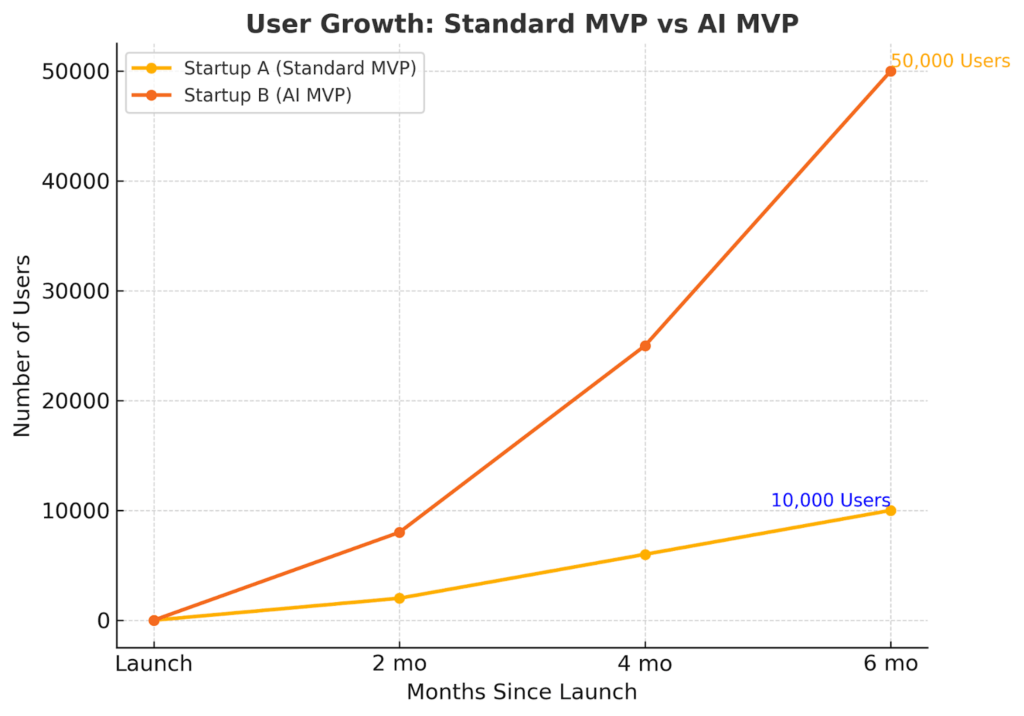
Guess which one raised their Series A?
The Intelligence Multiplication Effect: How AI MVPs Create Compound Value
When you build an MVP with AI, you’re not adding intelligence to your product; you’re making intelligence your product’s core operating system. This creates what I call the “Intelligence Multiplication Effect,” where every user interaction doesn’t just provide feedback, it exponentially increases your product’s capabilities.
The Three Pillars of AI MVP Success
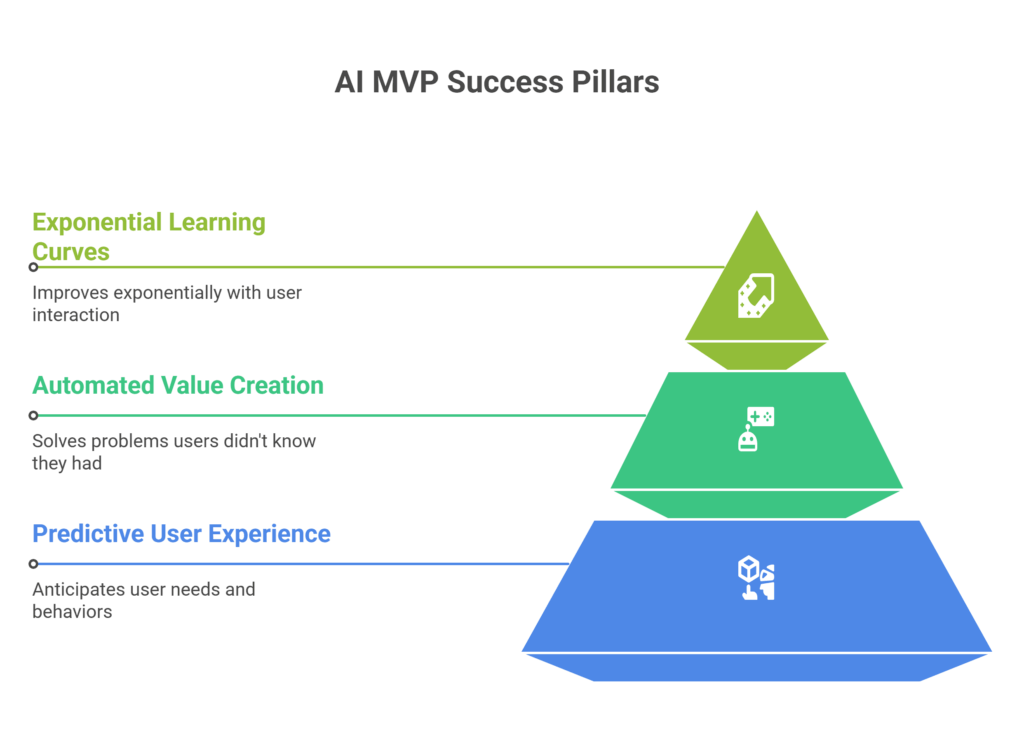
- Predictive User Experience: Conventional MVPs respond to the user. AI MVPs anticipate it. What if, instead of recording your workouts, there was an app that anticipates when you are likely to miss the gym by analyzing your schedule, the weather, and past habits, and then changes your workout to keep you going? It is not a futuristic thought, but it is taking place today.
- Automated Value Creation: The strongest AI MVPs not only solve the problem they are made to do, but also find solutions to problems that the user had no idea he or she was facing. The customer service AI can start with answering simple questions and develop further to predict customer needs, detect possible problems in advance, and even provide propositions to improve a product by analyzing the patterns of conversations with customers.
- Exponential Learning Curves: Here’s where the magic happens. Traditional products improve linearly i.e., you add features, users provide feedback, you iterate. AI MVPs get exponentially better. A new user not only increases your user base, but also increases your intelligence base. Even without a single line of manual updates, the 10,000th user is having an entirely different (and more desirable) product than the 100th user.
Real-World AI MVP Success Stories That Will Change How You Think About Product Development
The $50 Million Email Assistant That Started as a Simple Scheduling Tool
Calendly began as a basic appointment scheduling MVP. But founder Tope Awotona had a bigger picture than mere integration of a calendar. The introduction of AI into their architectural design at its inception made Calendly a scheduling app, but transformed it into a meeting optimization platform.
Now their AI can suggest the optimal time to meet and do so on the basis of productivity patterns, complex scheduling situations are automatically managed, and even propose a type of meeting depending on the preferences of the participants and how successful it has been in the past. It was this intelligence shift that has allowed Calendly to raise a 3 billion dollar valuation, not due to creating a better calendar, but due to creating a smarter calendar.
The Retail Revolution: How One AI MVP Disrupted an Entire Industry
Stitch Fix is not a fashion company; originally, they were a data company that sold clothes. Their MVP was not a shopping site; it was a system based on AI that acquired the individual style preferences based on user feedback and analyzed the behavior.
While traditional retailers were optimizing their websites, Stitch Fix was optimizing its algorithms. Each shipped box wasn’t just a sale; it was a data point that made their AI smarter. Their algorithms are so advanced today that they level of predicting fashion trends, inventory optimization, and shopping personalization at a scale that would never be achieved by a human stylist.
The result? They have taken over the market of retailers who have been in the business for centuries, and the reason is that they have developed their MVP using AI as the core of the MVP, as opposed to it being a secondary feature.
The Healthcare Breakthrough: From Simple Symptom Checker to Diagnostic Revolution
Babylon Health launched with a basic AI chatbot that could answer simple health questions. Most people saw it as a digital WebMD. But their vision was far more ambitious. They were building an AI system that could eventually rival human diagnostic capabilities.
Their MVP collected millions of symptom-outcome data points, learned from doctor consultations, and continuously improved its diagnostic accuracy. Today, their AI can identify certain conditions with accuracy rates that match or exceed human doctors, and they’re processing over 1 million medical consultations monthly.
They didn’t build a healthcare app; they built a learning medical intelligence that happens to operate through an app.
The Technical Blueprint: How to Actually Build AI MVPs That Scale
Phase 1: Intelligence Architecture Design
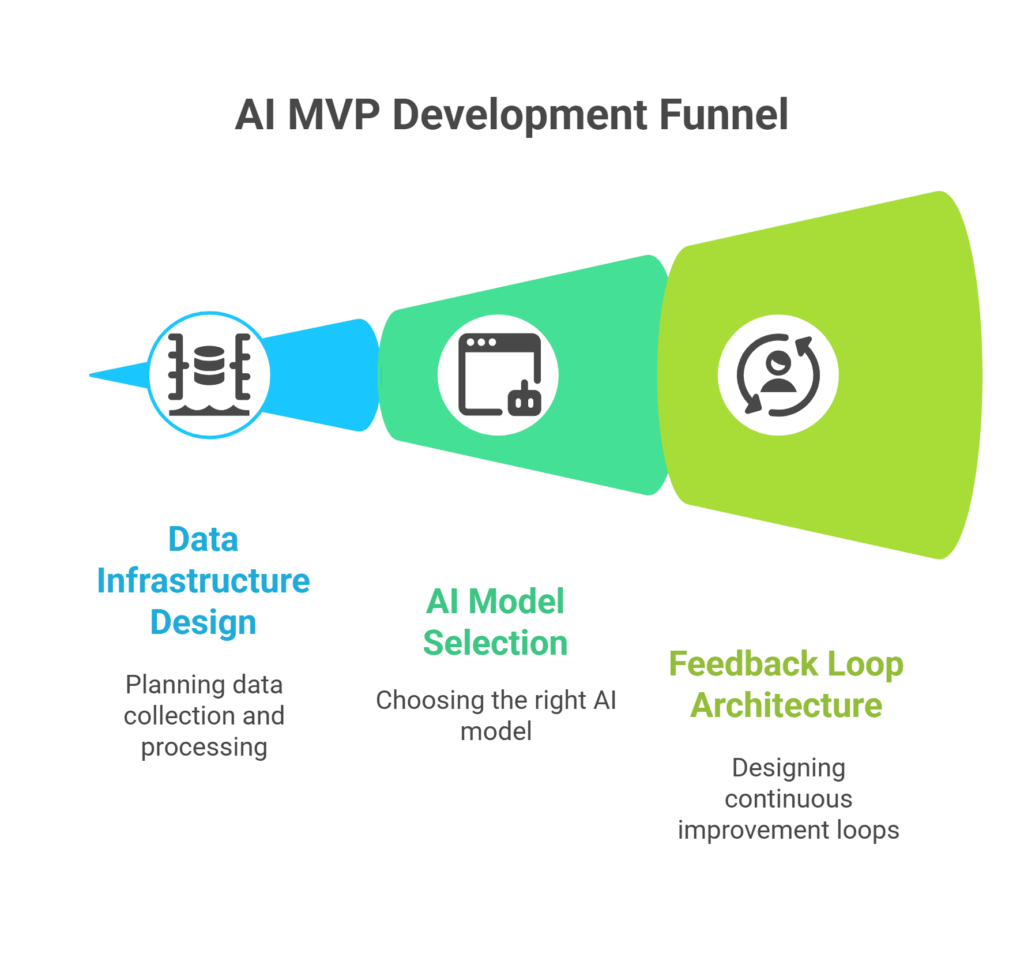
The biggest mistake most founders make is treating AI as a feature they’ll “add later.” Successful AI MVP development requires building intelligence into your product’s DNA from day one.
Data Infrastructure First: Design your data collection and processing pipeline first. Before writing a single line of application code, design how you will collect and process data. What will be the user interactions to provide learning data? What will you do to store and process this information? What are the privacy and security issues that you need to deal with?
This is not over-engineering; it is long-term building of strategy. Instagram’s early team spent weeks designing their image processing pipeline before building their first filter. The work of that foundation helped them to increase to millions of users without having to recreate their core infrastructure.
AI Model Selection Strategy: It will decide the scalability and competitive moat of your MVP depending on whether you use a pre-trained model, a fine-tuned solution, or your own algorithm. Language-based applications can be provided with immediate intelligence by pre-trained models such as GPT or BERT. Computer vision models can power image recognition features. The key is matching AI capabilities to your core value proposition.
Feedback Loop Architecture: Design multiple learning loops into your product. Your algorithms should improve user behavior, which should make user experience better, which should produce better data. This makes a process of cycles of improvement, which reinforces itself, your competitive advantage.
Phase 2: Minimum Viable Intelligence Implementation
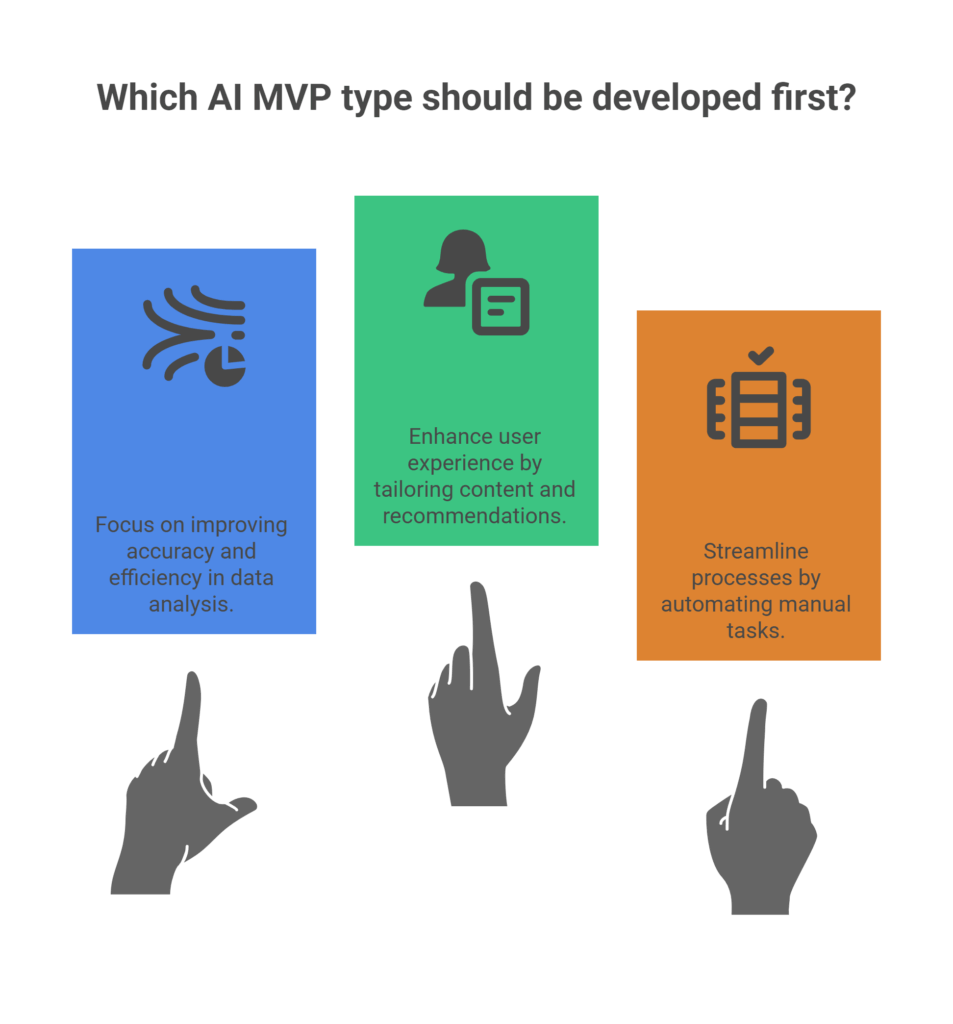
Start with the simplest AI capability that can validate your core hypothesis. This isn’t about building the most sophisticated systems but proving that intelligence can create genuine user value in your domain.
Pattern Recognition MVPs: In case your product is related to finding patterns in data, begin with the basic machine-learning models that can prove better accuracy or efficiency as compared to the manual processes.
Personalization MVPs: In any user application, basic personalization algorithms should be started, which can modify content, recommendations, or interfaces depending on the individual behavior patterns.
Automation MVPs: When you have a value proposal that is about automating manual processes, you should first start with the simplest rule-based systems, which can deal with the most frequent cases, and then gradually add more complex AI to the rule-based mechanisms as you collect additional data.
Phase 3: Intelligent Scaling and Evolution
Once your AI MVP starts to attract users and data, you are no longer interested in proving the concept. The focus now becomes on the intelligence multiplication effect.
Continuous Learning Implementation: Implement systems such that they automatically retrain as you have new data, and become better. It could be a daily update of the model of fast-moving applications or a weekly retraining in more stable areas.
Feature Discovery Through AI: Use your AI systems to identify new product opportunities. What patterns in user behavior suggest unmet needs? What will be the new value propositions in your data?
Competitive Intelligence Building: With more advanced AI systems, you can get data not only on your users but also on your market, competitors, and industry trends.
The Psychology of AI MVP User Adoption: Why Smart Products Win Hearts
Understanding user psychology is crucial when you build an MVP with AI. Users do not simply desire intelligent products, but products that allow them to feel intelligent.
The Intelligence Attribution Effect
Users attribute success to themselves and failures to the tool. Smart AI MVPs are designed to amplify user competence rather than replace user judgment. Netflix doesn’t just recommend movies; it makes users feel like they have great taste in films. Grammarly doesn’t just correct grammar; it makes users feel like better writers.
The Learning Partnership Model
The most influential AI MVPs make the user and the system seem to be partners. The AI is not performing tasks for the user or on behalf of the user it is learning alongside the user. Duolingo not only teaches languages, but it also studies the learning styles of each user and adjusts to them, forming an individual educational relationship.
The Transparency Advantage
Users trust AI systems they understand. Not only good engineering, but good psychology, explainable AI capabilities should be built into your MVP. People will be more willing to rely on the suggestions of your AI and stay with them as long as they know how it functions.
Advanced AI MVP Strategies: The Cutting-Edge Techniques Winning Markets
Multi-Modal Intelligence Integration
The new generation of AI MVPs does not simply process text or images; they combine various kinds of intelligence to develop more holistic solutions. To provide a complete fitness intelligence system, a fitness application may include computer vision (form analysis), natural language processing (coaching feedback), time series analysis (progress tracking), and recommendation systems (workout planning).
Federated Learning Implementation
In cases of MVPs dealing with sensitive data, you can use federated learning to have your AI get better without having to centralize the user information. Your models are more intelligent, and yet the privacy of the user is preserved, an important feature in health-related apps, finance applications, and personal productivity.
Edge AI Deployment
Deploying AI models directly to users’ devices will decrease latency, enhance privacy, and allow offline use. This is especially effective with mobile MVPs, where response and sensitivity of data are essential.
Common AI MVP Pitfalls and How to Avoid Them
The Feature Creep Trap
AI capabilities can be so exciting that founders try to implement everything at once. Focus on one core intelligent capability that creates genuine user value. Perfect, then expand.
The Black Box Problem
Unless users are able to trust or comprehend your AI, they will not use your product. Make your AI systems transparent and explainable not only towards the end but also at the very start.
The Data Quality Delusion
The quality of the AI systems is dependent on the quality of the data. Garbage in, garbage out isn’t just a saying; it’s a business reality. Invest in data quality and validation systems from day one.
The Scale Assumption Error
Assuming your AI will work at scale without testing is dangerous. What is good with 1000 users may fail with 100,000. Make your systems designed to scale gracefully, or gracefully degrade when they do not.
The Economic Impact: Why AI MVPs Command Premium Valuations
Investors are paying attention to the AI MVP revolution, and their wallets are following their attention. AI-powered startups are commanding premium valuations for three key reasons:
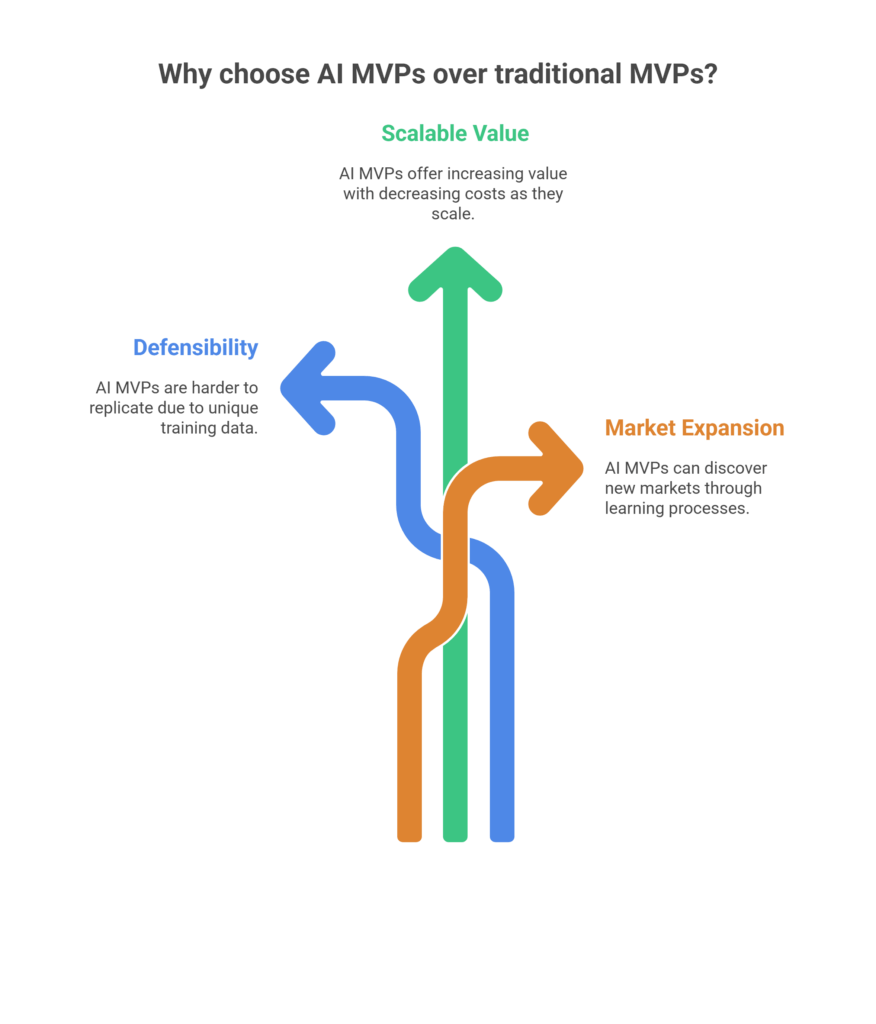
Defensibility Through Intelligence
Traditional MVPs can be copied. AI MVPs that have collected significant training data cannot. Your AI system becomes more valuable and more difficult to replicate with every user interaction.
Scalable Value Creation
Traditional products scale through adding resources. AI products scale through intelligence multiplication. The marginal cost of serving additional users decreases while the marginal value per user increases.
Market Expansion Potential
AI MVPs often discover new markets and use cases through their learning processes. Investors value this potential for organic growth beyond the initial target market.
The Future of AI MVP Development: What’s Coming Next
Autonomous Product Evolution
The next generation of AI MVPs won’t just learn from user behavior; they’ll autonomously generate and test new features. Imagine products that conduct their own A/B tests, implement successful variations, and evolve without human intervention.
Cross-Platform Intelligence Sharing
AI MVPs will begin sharing learning across different applications and domains. Your productivity app’s understanding of work patterns might improve your fitness app’s scheduling recommendations.
Predictive Market Creation
Advanced AI MVPs will identify and create new markets before human entrepreneurs even recognize that the opportunities exist. They’ll spot patterns in user behavior that suggest entirely new product categories.
Your AI MVP Development Action Plan: From Concept to Launch
Week 1-2: Intelligence Strategy Design
Define your AI value proposition. What specific intelligence will create user value? How will this intelligence improve over time? What data will fuel this improvement?
Week 3-4: Technical Architecture Planning
Design your data pipeline, select your AI models, and plan your feedback loops. This foundation work will determine everything that follows.
Week 5-8: Minimum Viable Intelligence Development
Build the simplest version of your intelligent system that can demonstrate value. Focus on proving the concept, not perfecting the implementation.
Week 9-12: User Testing and Learning Loop Optimization
Launch to a small user group and optimize your AI’s learning from their behavior. This is where you’ll discover whether your intelligence hypothesis was correct.
Month 4+: Scale and Evolve
Expand your user base while continuously improving your AI systems. Each new user should experience a better product than the previous user.
The Competitive Imperative: Why Waiting Isn’t an Option
Every day you delay implementing AI MVP development is a day your competitors are building more intelligent, more valuable, more defensible products. Competitive advantage through AI still has an open window, but it is closing fast.
The companies that master AI MVP development today will dominate their markets tomorrow. It will give them superior products, more active users, greater competitive advantages, and valuations. More to the point, they will be making products that self-assemble- creating value as their founders go to sleep, fixing issues before their users are aware of their existence, and developing further than their creators ever thought.
The Bottom Line: Intelligence as Your Ultimate Competitive Advantage
The shift from traditional MVP development to AI MVP development isn’t just a trend; it’s an evolution in how we create value. When you build an MVP with AI, you’re not just launching a product; you’re unleashing an intelligent system that becomes more valuable with every interaction.
The startups that understand this shift will build the next generation of market-defining companies. Those that don’t will find themselves competing with increasingly intelligent products using increasingly outdated approaches.
The choice is simple: Build smart, or watch smarter competitors build your market before you do.
Your AI MVP journey starts with a single question: What could your product accomplish if it could learn, adapt, and improve itself? The answer to that question might just be your path to market dominance.
Ready to transform your startup idea into an intelligent market force? The age of AI MVP development isn’t coming. It’s here. And it’s waiting for you to seize it.

 By
By
 By
By