
Imagine the following scene: Suddenly, you are a product engineer, and your phone rings again with another urgent request. The market changed overnight, a competitor has just released something game-changing, and your boss wants to know how fast you can change directions. Sound familiar?
And in case you are nodding your head, you are not alone. Everywhere, product engineering firms are under pressure. We find ourselves in a time when what was effective last year, or even last month, may already be obsolete. The old playbook of long development cycles and strict process? It is gathering dust, and the world is racing by.
But the thing is that with pressure comes opportunity. In fact, artificial intelligence is no longer a far-off idea, but a realistic solution in front of our faces that will transform how we make things forever.
Today, we will explore the revolutionary changes that AI is bringing to the sphere of product development and implement them step by step with examples of real-life applications, AI instruments, and ways to implement them into your product engineering workflow and simplify it.
Why AI is Changing the Game for Product Engineering Firms
Being a product engineer today feels like playing three games simultaneously, and the rules keep changing.
You’re not just tasked with building something amazing anymore. You must build it fast enough to beat the competition, accurate enough that it won’t blow up in your face, and cheap enough that the finance team doesn’t have a meltdown. Oh, and it better be exactly what customers want, not what you think they want.
It’s exhausting, right?
This is how AI is dealing with these issues:
- Automates repetitive tasks and speeds up production cycles.
- Delivers predictive analytics to make more thoughtful, data-driven selections.
- Generates insights from massive datasets, making designing products that meet consumer needs simpler.
- Enhances layout and customization for more personalized user experiences.
In essence, AI empowers product engineering firms to streamline their workflows and push the boundaries of innovation.
Let’s go through each step of the product development process and how AI is transforming it.
1. Ideation & Conceptualization
The ideation phase focuses on generating modern thoughts and defining the preliminary concept of the product. AI tools assist in studying market developments, consumer demands, and competitor statistics, supporting corporations in finding valuable product possibilities.

- MarketMuse
MarketMuse uses artificial intelligence to crawl content and find white spaces in the market to provide insights to develop distinctive and evidence-based product ideas.
URL: marketmuse.com - Frase
Frase uses AI to analyze search trends and consumer behavior, providing insights to guide ideation for new product development.
URL: frase.io - WriteSonic
WriteSonic uses AI to generate product ideas and copy based on current trends, helping ideate creative product names, descriptions, and positioning.
URL: writesonic.com
2. Design & Prototyping
The design and prototyping phase is essential for turning ideas into purposeful and testable prototypes. AI-powered layout tools can automate and optimize the design procedure, suggesting enhancements and assisting in creating accurate 3-D models and simulations.
- Autodesk Fusion 360
Fusion 360 uses AI to permit product designers and engineers to create 3-D models, simulate product functionality, and run assessments to ensure the design’s feasibility.
URL: autodesk.com - SketchUp
SketchUp’s AI capabilities enhance the design process by offering innovative suggestions and automatically adjusting designs for better performance and user experience.
URL: deepcode.ai - SolidWorks
SolidWorks leverages AI to optimize product designs, offering tools that simulate real-world scenarios and improve design accuracy.
URL: solidworks.com
3. Development & Engineering
During development, AI tools can optimize coding, debugging, and automate repetitive tasks to speed up the manufacturing process while minimizing human errors.
- DeepCode
DeepCode uses AI to analyze code, providing automated bug detection and code suggestions to improve the quality and speed of software development.
URL: deepcode.ai - Codex by OpenAI
Codex can automatically generate code based on natural language instructions, significantly speeding up the development phase and allowing engineers to focus on more complex tasks.
URL: openai.com - Kite
Kite uses AI to help developers write code faster by providing real-time code completions, function suggestions, and bug fixes.
URL: kite.com
4. Testing & Quality Assurance
The testing phase involves validating the product’s functionality, security, and performance. AI tools help automate test cases, predict potential bugs, and provide quality insights from data.
- Testim
Testim uses AI to create and execute automated tests that improve speed and efficiency in detecting bugs and improving product quality.
URL: testim.io - Applitools
Applitools utilizes AI-powered visual testing to ensure products are visually consistent and function correctly across different devices.
URL: applitools.com - Functionize
Functionize leverages AI for automated testing, helping teams run tests quickly and accurately while predicting potential issues before they arise.
URL: functionize.com
5. Launch & Marketing
The launch phase includes product marketing, customer segmentation, and identifying the best channels for distribution. AI tools predict customer behavior and help craft personalized marketing strategies to boost product reach and sales.

- HubSpot
HubSpot analyzes customer behavior and preferences using AI, helping teams design personalized marketing campaigns and launch strategies.
URL: hubspot.com - Hootsuite
Hootsuite’s AI-powered analytics help track social media trends and engagement, ensuring products are marketed effectively to the right audience.
URL: hootsuite.com - Mailchimp
Mailchimp uses AI to automate email marketing campaigns, segment audiences, and predict which content will perform best for product launches.
URL: mailchimp.com
6. Post-Launch Feedback & Iteration
After launching the product, AI tools continuously gather user feedback, monitor usage data, and provide insights for product improvements. This phase ensures that the product evolves to meet changing customer needs.

- Qualtrics
Qualtrics uses AI to analyze customer feedback and predict trends, enabling continuous product improvement and faster adaptation to user needs.
URL: qualtrics.com - UserTesting
UserTesting uses AI to analyze user behavior and feedback, helping teams identify pain points and areas for improvement in the product experience.
URL: usertesting.com - Pendo
Pendo leverages AI to track how users engage with a product, providing valuable insights to improve user experience and product functionality over time.
URL: pendo.io
While AI is an effective tool that automates obligations and improves performance, it’s essential to remember that it doesn’t replace human contact; it enhances it. Product engineering firms are full of creative minds, and AI is a powerful assistant that allows engineers, designers, and developers to focus on better-stage trouble-fixing and innovative thinking.
For instance, while AI can assist in writing code or laying out prototypes, the human team members convey their experience, intuition, and innovation to refine the designs or resolve complicated problems that AI can’t predict. Think of AI as the ultimate group participant, handling repetitive obligations and giving groups the distance to think outside the box.
By streamlining repetitive workflows and imparting fact-backed insights, AI empowers engineers to make quicker, more intelligent choices. This accelerates product improvement and encourages teams to discover modern solutions, ensuring the products they develop resonate with top customers.
Conclusion: AI is the Future of Product Engineering
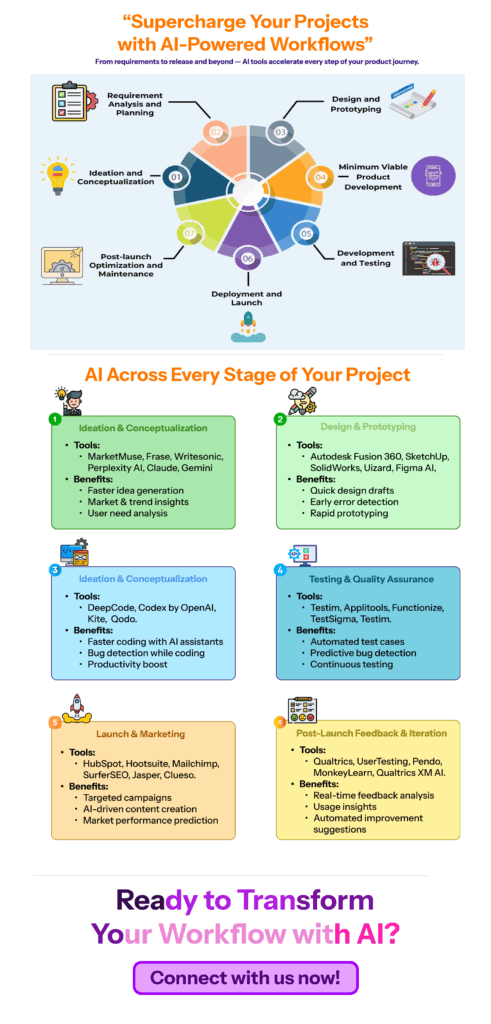
AI is not just a trend; it’s a revolution reshaping how product engineering firms expand and bring merchandise to the marketplace. From ideation to launch, AI makes the process quicker, smarter, and more efficient. By incorporating AI into each phase of product improvement, a Digital product engineering company can effectively enhance its improvement timelines and deliver better, extra personalised products to its clients.
The future of product engineering is right here, and AI is leading the way. The strategies shared on this blog provide a roadmap for how AI can assist in taking your product engineering efforts to the next level.

 By
By
 By
By